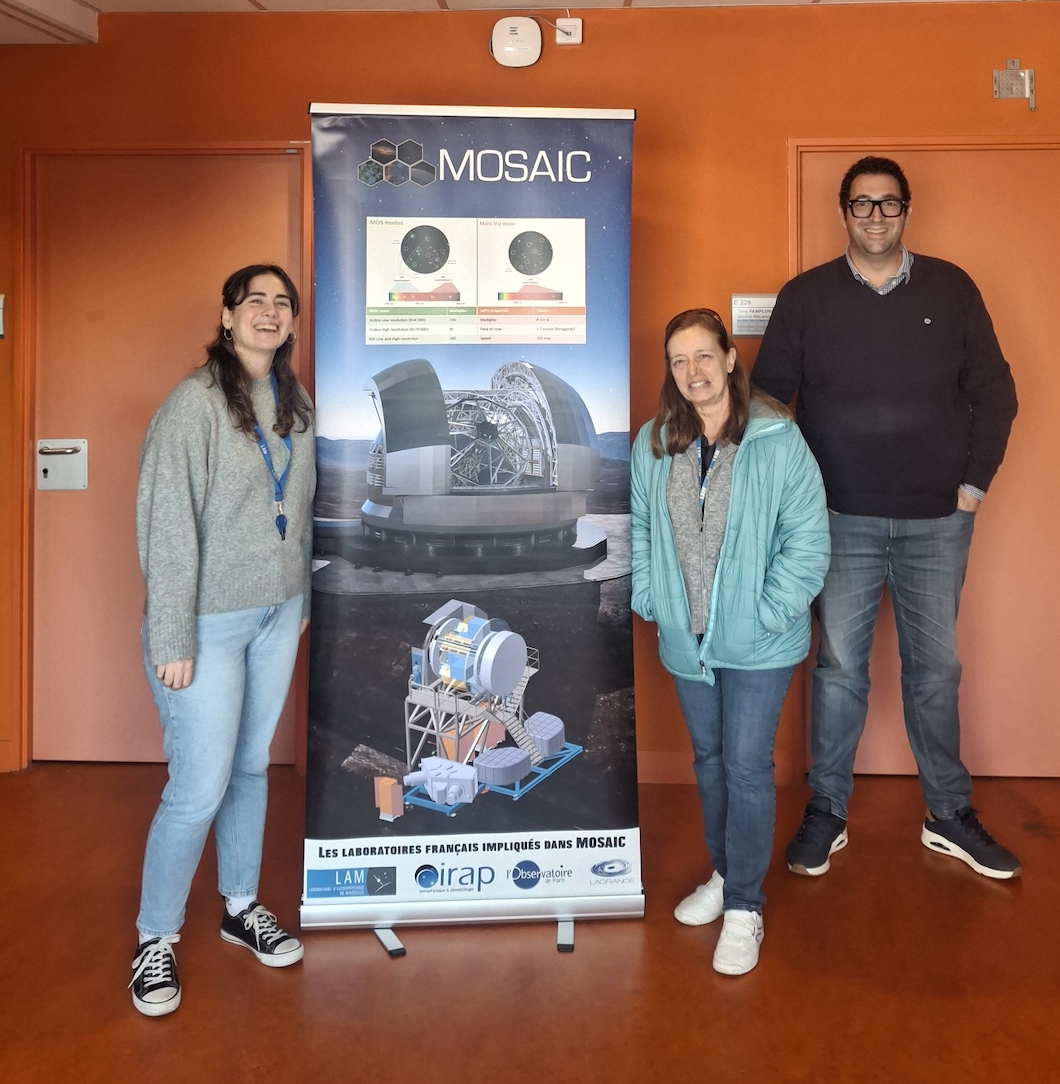
The GUAIX researcher is collaborating with Roser Pelló and Nicolas Laporte to study extreme emission line galaxies and their connection to galaxy mergers.
María Delgado is undertaking a research stay from October 1 to November 15, 2026, at the Laboratoire d’Astrophysique de Marseille (LAM), France, where she is collaborating with astrophysicists Roser Pelló and Nicolas Laporte. During her stay, she is continuing her research on Extreme Emission Line Galaxies (EELGs) observed during the epoch known as Cosmic Noon, a period of intense star formation in the history of the Universe.
These galaxies have characteristics that make them useful analogues of the sources that contributed to cosmic reionization. Her research is based on a sample of galaxies selected from the Extended Groth Strip (EGS) field of the CANDELS project, using observations from the Hubble Space Telescope (HST).
Thanks to new observations obtained with the James Webb Space Telescope (JWST), previously undetected companion galaxies have been identified, suggesting the possible presence of galaxy mergers. The main objective of this research stay is to determine how frequently EELGs are associated with merger events and to compare these findings with the general galaxy population at similar redshifts.
As part of her research activities, María Delgado will also give a seminar on November 13 entitled “From Cosmic Noon to Cosmic Dawn: Extreme Emission Line Galaxies as Tracers of Reionization”, in which she will discuss the role of these galaxies in understanding the processes that led to the reionization of the early Universe.
This research will contribute to a better understanding of the mechanisms driving galaxy formation and evolution, as well as the role of galaxy interactions in these processes.