
We have developed predictions for next-generation metre-wavelength RM grids with SKA-Low, showing that it will deliver a step change in sensitivity and source density for studies of cosmic magnetism. SKA-Low is expected to provide an order-of-magnitude improvement over current low-frequency RM grids (ie. the LOFAR RM Grid), with source densities of several RMs per square degree and with exceptional RM precision. These advances will enable precision constraints on the origin and evolution of cosmic magnetic fields, from galaxy halos to the cosmic web.
RM Grid predictions for SKA-Low: O’Sullivan et al. (2026), Advancing Astrophysics with the SKA – II, AASKAII/OSullivan01
The full index of contributions can be found here: Advancing Astrophysics with the SKA II
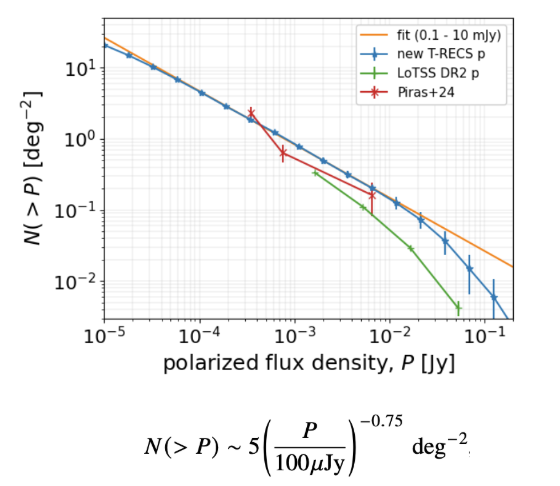
Cumulative polarized-source number counts: updated T-RECS polarization (blue), LOFAR deep field polarized source counts from Piras et al. (2024) (red), LoTSS DR2 RM Grid counts (green), power- law fit to model between 0.1 and 10 mJy (orange).
We have also implemented direction-dependent Faraday synthesis within DDFacet in Gustaffson et al. (2025), enabling more accurate wide-field polarimetric imaging by jointly reconstructing sky position and Faraday depth while correcting for instrumental and ionospheric effects. Applied to SKA data, this approach will improve polarized source recovery, reduce imaging artefacts, and enable deeper, higher-fidelity RM surveys across wide fields, particularly for faint and complex polarized sources.